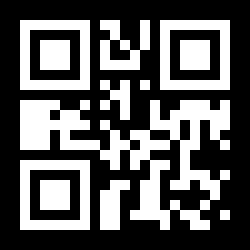
What Is a Vector QR Code?
A vector QR code is a QR code saved as an SVG file. Instead of storing a fixed grid of pixels the way a PNG or JPG does, an SVG stores the code as mathematical paths - pure shapes described by coordinates. That means it can be scaled to any size, from a 1 cm sticker to a wall-sized banner, and the edges stay crisp every time. There is no resolution to run out of and nothing to pixelate.
The free SVG QR code generator above produces exactly this: paste a link, and download a true vector SVG or EPS (plus PNG and JPG if you need a raster copy). It's a free vector QR code generator in the full sense - static QR codes are free forever, no watermark, no expiry - so the SVG file is yours to print at any scale you like.
Call it a QR code vector, a vector QR code, or an SVG QR code - it is the same file, and this is the QR code generator (SVG, EPS) that makes it. That's the right tool when you're starting from a link. If you already have the QR code as an image - a PNG someone sent you, a screenshot, a photo of a printed code - you don't need to recreate it by hand: to vectorize a QR code you already have, the QR code to SVG converter reads the existing code and gives you back the same one as a vector.
How to Download a Vector (SVG) QR Code
- Open the free generator. Use the generator at the top of this page - it's a QR code generator with vector output (SVG and EPS) as well as QR code PNG and JPG. The static QR code generator is free forever, with no account required and no watermark.
- Paste your link. Enter the URL you want the QR code to encode. The preview renders instantly as you type.
- Choose the SVG or EPS download. Pick SVG or EPS to get a genuine vector file. Both open in Illustrator, Inkscape, Affinity Designer, CorelDRAW, or any design app - EPS is the one some commercial printers ask for by name. PNG and JPG downloads are right there too.
- Scale it to any size. Drop the SVG into your layout and resize it freely - the code stays razor-sharp whether it ends up on a label or a billboard.
Where Vector QR Codes Matter
Large-Format Posters & Billboards
Blow the code up to poster or billboard scale with zero blurring - a vector never pixelates. Pairs perfectly with QR codes for posters.
Packaging & Labels
Print shops and packaging designers prefer SVG because it drops cleanly into artwork and prints at any dpi without an upscale step.
Laser Engraving, Cutting & CNC
Machines that follow paths - laser cutters, engravers, CNC routers - need vector input. An SVG QR code feeds straight into the toolpath.
Embroidery & Screen Print
Vector artwork converts to stitch files and screen separations far more cleanly than a raster image, keeping the code's edges precise.
Signage & Storefronts
Window decals, banners, and wayfinding signs get resized constantly. A vector master file scales to each without a re-export.
Editorial & Print Layout
Designers placing a code in a magazine, catalog, or brochure can scale the SVG to fit any column width and still print at full press resolution.
SVG vs PNG vs EPS for QR Code Print Files
All three download free here, so the only question is which one your job actually needs. SVG is the modern default, an EPS QR code is what some commercial printers still ask for by name (this is an EPS QR code generator too - same button row), and PNG is for screens.
| SVG (vector) | EPS (vector) | PNG (raster) | |
|---|---|---|---|
| Scales to any size | Yes - infinitely, stays sharp | Yes - infinitely, stays sharp | Only down to its pixel size; enlarging softens edges |
| Best print use | Posters, billboards, packaging, signage, engraving | Commercial print shops and older prepress workflows | Screen use and small fixed-size prints |
| Editable in design tools | Yes - paths, colors, and shapes stay editable | Yes - opens as editable paths in Illustrator/CorelDRAW | No - flat pixels only |
| Opens in a browser | Yes - natively | No - needs a design app | Yes |
| Transparent background | Yes | Yes | Yes |
| Machine input (laser/CNC) | Yes - path-based | Yes - path-based | Needs tracing first |
| Cost on EZQR | Free forever, no watermark | Free forever, no watermark | Free forever, no watermark |
Short version: use SVG unless a printer specifically requests EPS, and keep PNG for web, email, and slide decks. There's no quality difference between SVG and EPS here - both are true vectors carrying the identical pattern.
Placeholder & Sample QR Codes for Mockups
Designers and developers often need a QR code that isn't for anything yet - a placeholder QR code to sit in a packaging comp, a dummy QR code SVG for a wireframe, or a sample QR code as a test fixture in a component library. A greyed-out box shaped like a QR code is the usual stand-in, and it always misleads: real QR patterns have a specific visual density and quiet zone that change how the layout reads.
Generate a real one instead. Point the generator above at any placeholder URL -
your own homepage, or https://example.com - and download the SVG.
It costs nothing, it's a genuine scannable code rather than a picture of one,
and because it's a vector it drops into a mockup at any size without
pixelating. When the real destination is decided, regenerate it with the final
link and swap the file; the layout doesn't shift, because the pattern occupies
the same space.
One thing worth knowing: a QR code's pattern gets denser the more data you encode, so a placeholder built from a short URL will look visually simpler than a final code built from a long tracking link. If the mockup needs to represent the real thing faithfully, generate the placeholder from a URL of roughly the length you expect to ship.
How to Pick a QR Code Generator That Outputs Vector Files
Most generators offer a PNG and stop there, so the thing to check is whether you can actually get a real vector out. Four things worth confirming before you commit a print job to one:
- Does it export SVG or EPS at all - without an account? Plenty of tools put vector export behind a signup or a paid tier. Static QR codes here download as SVG and EPS free, with no account.
- Is the "vector" a real vector, or a PNG in a wrapper? Some exports embed a raster image inside an SVG file. It has the right extension and still pixelates. Open it and zoom in - a genuine vector stays crisp, and its paths are selectable in Illustrator or Inkscape.
- Does the pattern export as one shape or thousands of squares? Per-module exports leave hairline gaps that show up as white lines when you scale the code. Ours renders as one merged path per layer, so there are no seams at any size.
- Is there a watermark or an expiry? A code that expires is fine on a web page and a disaster on packaging. Static codes here have no watermark and no expiry - the destination is encoded in the pattern itself, so nothing has to stay online for it to work.
Vector QR Codes With Logos & Color
Need the vector file to carry your branding too? The custom QR code generator exports an SVG with your logo dropped in the center, brand colors or gradients, custom dot and corner shapes, and an optional transparent background - all in the same infinitely scalable vector format. It's the go-to when you want a QR code with a logo or a colored QR code that still holds up at large print sizes.
Common Questions
What is a vector QR code?
A vector QR code is an SVG file made of mathematical paths rather than a fixed grid of pixels. Because it stores shapes instead of dots, it stays perfectly sharp at any size - from a business card to a billboard - with no blurring or jagged edges.
How do I download a QR code as a vector (SVG) file?
Paste your link into the generator at the top of this page, then choose the SVG download. The file saves as a true vector you can open in Illustrator, Inkscape, Affinity Designer, or any design tool. PNG and JPG downloads are available too if you need a raster image.
Is the vector (SVG) QR code download free?
Yes. Static QR codes from EZQR are free forever - SVG, PNG, and JPG downloads with no watermark and no expiry. The vector SVG is the same free download, ready for professional print.
Is this a free SVG QR code generator?
Yes - the generator on this page is a free SVG QR code generator. Paste a link and download the code as an SVG (a true vector), or as EPS, PNG, or JPG. There's no watermark, no expiry, and no account needed for static codes, so it works as a free vector QR code generator for print or screen.
SVG vs PNG - which QR code format should I use for print?
Use SVG whenever the code will be resized or printed large. As a vector, SVG scales to any dimension without losing sharpness. PNG is a raster image fixed at its pixel dimensions, so blowing it up past its native size makes the edges soft. For posters, packaging, and signage, SVG is the safe choice.
Can I get a vector QR code with a logo and custom colors?
Yes. The custom QR code generator exports an SVG with your logo, brand colors, gradients, custom dot and corner shapes, and an optional transparent background - all in the same infinitely scalable vector format.
Will a vector QR code still scan reliably?
Yes. The SVG encodes the exact same pattern as the raster versions, so it scans identically. Keep good contrast between the code and its background, and test with a couple of phones before printing in bulk.
Can I download the QR code as an EPS file?
Yes. EZQR exports EPS directly, alongside SVG, PNG, and JPG. EPS is a true vector format, so - like the SVG - it stays perfectly sharp at any print size and drops straight into Illustrator, CorelDRAW, or a commercial print shop's workflow with no conversion step. Reach for EPS when a printer specifically asks for it; otherwise SVG works everywhere modern.
Where can I get a placeholder or dummy QR code SVG for a mockup?
Generate a real one here rather than using a grey box. Point the generator at
any stand-in URL - your homepage, or https://example.com - and
download the SVG. It's free, it's a genuinely scannable code instead of a
picture of one, and as a vector it scales into a mockup at any size without
pixelating. Swap in the final link later and the layout won't shift. See the
placeholder section above for the one
density caveat.
Can I get a 4K or higher-resolution QR code?
Yes - download the SVG or EPS. A vector QR code has no resolution at all, so it renders at 4K, 8K, or any print size with perfectly sharp edges; there is nothing to upscale. Open it in your design tool or print workflow and export at whatever pixel size or dpi the job needs. The PNG and JPG downloads here are fixed-size raster copies meant for screens and small prints, so for high-resolution output always start from the vector.
What format and resolution is best for a high-quality printed QR code?
SVG is the best format for a high-quality print because it's resolution-independent - it stays crisp at any size and any dpi, so there's no minimum resolution to worry about. If you must use a raster format, export the PNG at 300 dpi or higher for the final printed size. For sizing, 2 cm (about 0.8 inch) wide is a safe minimum for codes scanned up close; scale up for greater scan distance (roughly scan distance ÷ 10 = code width). See QR codes for printing for more size guidance.